
Quick Summary: Starting with tax year 2026, employers must report cash tips in Box 12 with code TP, qualified overtime compensation in Box 12 with code TT, and applicable Treasury tipped occupation codes in Box 14b. Code TT covers only pay above the employee’s regular rate that the FLSA requires, generally the extra half of time-and-a-half pay; code TP covers cash tips reported to the employer, while the deduction is limited to voluntary tips earned in qualifying occupations. The IRS transition relief applied only to 2025, so review payroll and POS mappings now.
If you have tipped or overtime staff, Box 12 code TT is one of the 2026 W-2 changes you need to prepare for now. The IRS also added code TP for cash tips reported to the employer and Box 14b for Treasury tipped occupation codes. These fields are mandatory for 2026 reporting, so your payroll and point-of-sale systems must capture the right data before year-end.
Qualified overtime is limited to FLSA-required pay above the regular rate, and the qualified tips deduction applies only to voluntary tips earned in eligible occupations. Reporting the wrong amount can understate an employee deduction or create an avoidable mismatch with IRS records.
If you want the wider context on what the law changed across the board, our post on what payroll teams must do in 2026 under the OBBBA covers the full picture. This one narrows in on the two boxes and what has to change in your system before December.
What Changed on the 2026 Form W-2
Starting with the 2026 tax year, employers must report cash tips and qualified overtime separately on Form W-2. The IRS 2026 General Instructions for Forms W-2 and W-3 assign code TP to total cash tips reported to the employer, code TT to qualified overtime compensation, and Box 14b to Treasury tipped occupation codes.
Each of these exists because the One Big Beautiful Bill Act created a deduction employees can claim on their returns, and the IRS needs a clean, separately reported figure to support that deduction instead of asking employees to reconstruct it themselves.
For payroll teams, this means the reporting change is really a system configuration change that has to happen months before the W-2 is generated, not a filing season adjustment.
What Is Box 12 Code TP on the 2026 W-2?
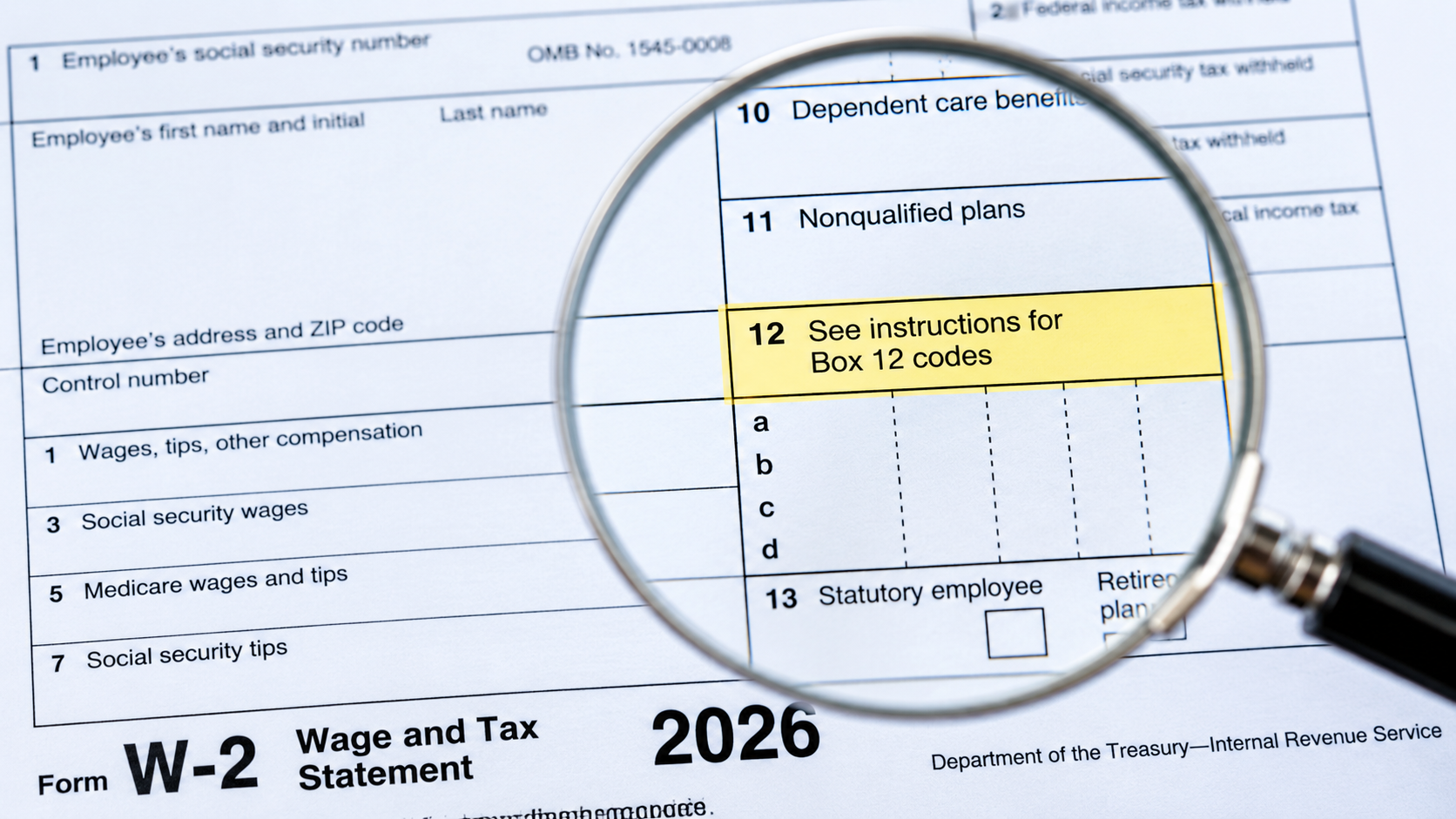
Box 12 code TP reports the total cash tips an employee reported to the employer, including voluntary cash or charged tips and tips received through tip-sharing arrangements.
The amount remains separate from existing Social Security and Medicare wage boxes. Payroll must also pair code TP with the correct Box 14b occupation code because deduction eligibility depends on the employee’s occupation.
If your point-of-sale and payroll systems do not isolate reported tips by employee and occupation, close that gap before the next W-2 run.
What Is Box 12 Code TT on the 2026 W-2?
Box 12 code TT reports total qualified overtime compensation, meaning the amount above the employee’s regular rate that federal law requires under section 7 of the FLSA. Consider an employee who earns $20 an hour and works 45 hours in a week.
That employee earns time and a half on the 5 overtime hours, which works out to 30 dollars an hour for those hours. The qualified overtime figure that belongs in Box 12 code TT is the 5 hours times the $10 premium, not the 5 hours times the full $30 rate.
Reporting the full time-and-a-half payment instead of the premium portion overstates the deduction figure and creates exactly the kind of mismatch the IRS can question later.
Box 14b and the Treasury Tipped Occupation Code
Box 14b is new for 2026 and reports up to two Treasury tipped occupation codes when cash tips appear under code TP. If an employee received tips in more than two occupations, report codes for any two. If any tips came from a nonqualifying occupation, one code must be 000. Audit job classifications now so each tipped employee receives the right code.
| Box | What It Reports | Who Configures It |
| Box 12 TP | Total cash tips reported to employer | Payroll and POS integration |
| Box 12 TT | Premium portion of qualified overtime only | Earnings code mapping |
| Box 14b | Treasury-tipped occupation code | HR job classification |
What Counts as a Qualified Tip and What Does Not
A qualified tip must be a voluntary cash or charged tip, including one received through a tip-sharing arrangement, and the worker must be in a Treasury-listed tipped occupation.
Mandatory service charges and automatic gratuities are wages, not tips. Configure the POS so voluntary tips and service charges feed payroll separately, and verify each tipped job against the IRS occupation list before assigning Box 14b.
The 2025 Penalty Relief Is Gone
The IRS transition penalty relief applied only to tax year 2025. For 2026 reporting, employers should plan for the standard accuracy and information-return rules.
Waiting until January does not make reconstruction impossible, but it makes the work slower and more error-prone when payroll and POS systems do not preserve separate tip, service-charge, and overtime-premium totals.
What Louisiana Restaurants and Hotels Should Configure First
Baton Rouge, New Orleans, and River Parish restaurants, hotels, and hospitality operators carry the heaviest version of this reporting burden because tipped and overtime-heavy staff are the norm rather than the exception. The first configuration priority is separating voluntary tips from mandatory service charges in the point-of-sale system, since that separation has to happen at the point of sale before the data ever reaches payroll.
The second priority is mapping earnings codes so overtime premium is calculated and stored separately from base overtime pay rather than as one combined figure. The third priority is assigning Treasury-tipped occupation codes to every tipped role across every location, which for a multi-location operator means auditing job titles that may not yet be standardized.
Our restaurant and hospitality payroll for tipped and hourly staff page covers the full range of issues specific to this vertical if you want a broader starting point.
A Mid-Year Payroll Audit You Can Run This Week
Three checks tell you where you stand right now. First, pull a sample pay period and confirm whether your system can isolate the overtime premium from the full-time-and-a-half payment or whether it is only storing the combined figure.
Second, check whether your point-of-sale export separates voluntary tips from automatic gratuities or whether both land in a single tip total.
Third, confirm whether your current job classifications map cleanly to Treasury-tipped occupation codes or whether that mapping still needs to be built.
Any one of these three gaps is fixable in a single configuration session with a payroll provider, but only if it is caught in August rather than discovered while generating W-2 forms in January.
Louisiana employers coming up on their filing obligations should also check our Baton Rouge payroll tax deadlines and filing checklist so the tip and overtime configuration work lines up with the rest of the year-end calendar.
Getting Tipped Employees Off Paper Checks While You Are In There
If you are already updating payroll for 2026 W-2 reporting, use the same project to move tipped and hourly employees from paper checks to direct deposit or Rapid Cards. Louisiana storms can delay FedEx paper-check deliveries, leaving employees without wages on payday. Coeur’s payroll management services help employees receive pay on time without relying on a delivered check.
Frequently Asked Questions
What is Box 12 code TP on the 2026 W-2?
Box 12 code TP reports the total cash tips an employee reported to the employer, including voluntary cash or charged tips and tips received through tip-sharing arrangements. This amount is separate from existing wage and tax boxes. Payroll must also report the applicable Treasury tipped occupation code in Box 14b.
What is Box 12 code TT on the 2026 W-2?
Box 12 code TT reports qualified overtime compensation, meaning pay above the employee’s regular rate that is required under section 7 of the Fair Labor Standards Act. For standard time-and-a-half overtime, report only the extra half, not the employee’s regular pay or the full overtime payment.
Are automatic gratuities and service charges qualified tips?
No. Mandatory service charges and automatic gratuities are wages, not voluntary tips, so they do not qualify for the deduction. A qualified tip must be a voluntary cash or charged tip, including an amount received through tip sharing, and it must be earned in an occupation on the Treasury’s qualifying list.
Is there still penalty relief available for tip and overtime reporting?
No. The IRS transitional penalty relief applies only to tax year 2025. For 2026 W-2 reporting, employers should expect the standard accuracy and information-return rules to apply. Configure separate tracking for reported cash tips, service charges, FLSA-required overtime premiums, and occupation codes before year end.
What do I need to change in payroll before December 2026?
Create or map earnings codes that isolate the FLSA-required overtime premium from other overtime pay. Separate reported cash tips from service charges in your point-of-sale and payroll feeds. Assign the correct Treasury tipped occupation code to each tipped role, then run a test W-2 to confirm every value lands correctly.
Does this rule apply to salaried employees who get overtime?
Yes, if the salaried employee is nonexempt and receives overtime pay required by section 7 of the Fair Labor Standards Act (FLSA). Salary status alone does not decide eligibility. Report only the required amount above the employee’s regular rate, not overtime paid solely under a company policy or another arrangement.
Talk to us before your W-2s do the talking for you.
January Is Too Late to Start Tracking This
The 2026 W-2 changes are straightforward, but late corrections create avoidable work. Each pay period that combines the FLSA overtime premium with other overtime pay or mixes reported cash tips with service charges adds records your team may need to reconcile before filing. Configure the earnings codes, POS feeds, and occupation mappings now, then test a sample W-2 before year end.
Coeur has handled Louisiana payroll for 24 years, and our payroll management services team configures earnings codes, tip separation, and W-2 mapping as part of the work, not as a change order. If you are weighing whether to keep doing this in-house, our breakdown of local versus national payroll providers is a fair place to start. Either way, get a quote, and we will tell you what your current setup is missing.