
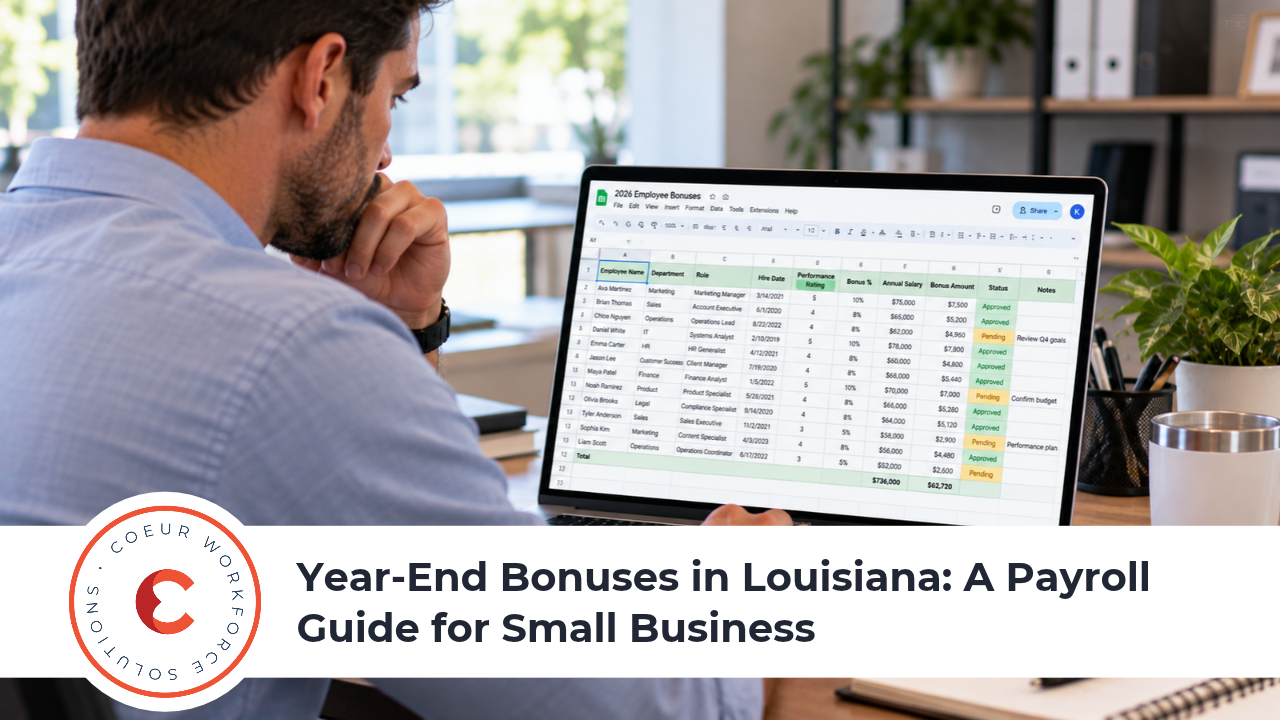
A year-end bonus can be a great way to thank your employees, but year-end bonus payroll in Louisiana needs more planning than simply choosing an amount and adding it to a paycheck. Different bonus arrangements can affect federal withholding and, in some cases, overtime calculations.
For Louisiana business owners already juggling year-end deadlines, the simplest approach is to make bonus planning part of your regular payroll process. Reviewing current Louisiana payroll laws for employers before the final payroll runs can also help prevent rushed corrections in December.
Whether you run a small office in Baton Rouge, a restaurant in New Orleans, or a growing team anywhere across Louisiana, the goal is the same: a bonus that feels like good news instead of a cleanup project in January.
Why Year-End Bonuses Belong in Your Payroll Plan
For payroll purposes, a bonus is generally compensation. It doesn’t matter whether you call it a holiday bonus, a thank-you, or a year-end reward. If you’re paying an employee because of their work, the payment typically needs to be documented and processed like wages.
It helps to separate two decisions. The first is a business decision: who receives a bonus and how much. That part is yours to make. The second is a payroll decision: how the payment is withheld, reported, and recorded once the first choice is made. That part comes with rules.
Running employee bonus payroll through your regular system keeps withholding accurate, places the payment on the employee’s Form W-2, and gives you a clean record if questions come up later. Handing out checks or cash outside of payroll skips all of that and usually creates extra work after the new year.
How Are Employee Bonuses Taxed in 2026?

The IRS treats bonuses as supplemental wages, a category that also includes commissions, overtime pay, and certain other payments. IRS Publication 15 describes two main ways employers can handle federal income tax withholding on them.
The first is the optional flat rate method. When supplemental wages are separately identified from regular wages and certain conditions are met, an employer may generally withhold federal income tax at a flat 22 percent. If an employee’s supplemental wages for the year exceed $1 million, a mandatory 37 percent rate applies to the amount above that threshold.
The second is the aggregate method. Here, the bonus is combined with regular wages for the pay period, and withholding is figured on the total as though it were a single regular payment. Depending on the employee’s pay and Form W-4, the result can be higher or lower than the flat method.
Either way, Social Security and Medicare taxes generally still apply to bonus pay, and Louisiana state income tax withholding needs to be handled correctly as well.
One caution when talking about holiday bonus taxes with your team: avoid saying that every bonus is simply taxed at 22 percent. That figure is a withholding method, not the employee’s final tax rate. Their actual tax is settled when they file a return, and the amount withheld may end up being more or less than what they owe.
Does a Year-End Bonus Change Overtime Pay?
This is the question that catches many small employers off guard. Under the Fair Labor Standards Act, the answer depends on whether the bonus is discretionary or nondiscretionary.
A truly discretionary bonus is one where the employer keeps control over whether to pay it and how much to pay until at or near the end of the period, and employees weren’t promised it in advance. These bonuses may generally be excluded from the regular rate of pay.
A nondiscretionary bonus is one employees expect because it was announced, promised, or tied to a formula. Production bonuses, attendance bonuses, safety bonuses, and payouts for hitting set goals usually fall into this group. For nonexempt employees, these payments may need to be included in the regular rate, which can mean additional overtime is owed for weeks in the bonus period when the employee worked more than 40 hours.
Discretionary Bonus vs. Nondiscretionary Bonus
| Bonus Type | Example | Overtime Impact | Payroll Consideration |
|---|---|---|---|
| Discretionary | An unannounced year-end gift whose amount is decided in December | Generally excluded from the regular rate | Document that both the decision and the amount were at the employer’s discretion |
| Nondiscretionary | A promised holiday bonus, attendance incentive, or goal-based payout | May need to be included in the regular rate for nonexempt employees | Allocate across the earning period and check whether additional overtime is owed |
Note that the label alone doesn’t decide the treatment. A payment called a holiday bonus can still be nondiscretionary if employees were told to expect it.
Getting this right depends on accurate hours for every week the bonus covers. If time records are scattered across paper sheets and text messages, recalculating overtime becomes guesswork. Coeur’s guide to how scheduling and attendance connect to accurate payroll explains why clean hours data makes these calculations far easier.
Five Questions to Answer Before You Run the Bonus Payroll
Before you submit bonus amounts, work through these five questions. Your answers will shape how the payment is processed and how employees experience it.
1. Who is eligible?
Decide whether bonuses go to all employees, full-time staff only, or specific roles, and whether recent hires or employees who have given notice qualify. Apply the rule consistently.
2. How is the amount determined?
A flat amount, a percentage of pay, and a performance-based figure are all common. Write the method down so every manager answers questions the same way.
3. Is the bonus discretionary or tied to predetermined goals?
This answer drives overtime treatment for nonexempt employees, so settle it before payroll runs rather than after.
4. Will it be paid with regular wages or separately?
Paying the bonus in a separate run, or separately identifying it on the same paycheck, can change which withholding methods are available.
5. When must payroll information be submitted so employees receive funds on time?
Work backward from the date you want the money in employees’ accounts, and account for banking holidays around Thanksgiving, Christmas, and New Year’s Day.
Once these questions are settled, document the decision consistently and tell employees when to expect the payment. Clear communication heads off a lot of questions during the busiest weeks of the year.
Don’t Let a Bonus Create a Year-End Cash Flow Surprise

The number you announce isn’t the full cost of the bonus. As the employer, you also owe your share of Social Security and Medicare taxes on the payment. Depending on each employee’s earnings for the year, federal and state unemployment taxes may also apply, although many employees reach those wage bases before December.
If your retirement plan counts bonuses as eligible compensation, an employer match may be triggered too. Add these costs to regular December payroll, benefit deductions, and other year-end expenses so the full picture fits comfortably in your cash flow.
Timing matters as much as the amount. Year-end is also when quarterly and annual filings stack up, so review the Baton Rouge payroll tax deadlines and filing checklist before the final payroll cycle of the year.
Make Bonus Delivery Simple for Employees
How the bonus arrives matters, too. Direct deposit gives employees predictable access to their money without depending on a printed check, mail delivery, or someone being in the office to hand it out during a holiday week.
For employees who don’t use traditional bank accounts, Rapid Cards provide an electronic payroll option, so they receive their bonus on the same timeline as everyone else. Whichever method you use, confirm that employee payment information is current before the bonus run.
Frequently Asked Questions About Year-End Bonus Payroll
Are year-end bonuses taxed differently in Louisiana?
Year-end bonuses are generally treated as supplemental wages for federal withholding purposes. Depending on how the payment is processed, an employer may use an IRS-permitted supplemental wage method. Louisiana withholding and normal payroll taxes also need to be handled correctly, so bonuses should generally run through the employer’s payroll system.
How much federal tax should an employer withhold from a bonus?
For qualifying supplemental wages separately identified from regular wages, the IRS generally allows a flat 22 percent federal income tax withholding method when the employee’s supplemental wages don’t exceed $1 million for the year. Employers may also have an aggregate method available depending on the circumstances.
Does a year-end bonus affect overtime pay?
It can. A promised or formula-based bonus may be considered nondiscretionary and may need to be included in the employee’s regular rate when calculating overtime. A truly discretionary bonus may generally be excluded. The label “holiday bonus” alone doesn’t determine how the payment should be treated.
Can a Louisiana small business give employees cash as a holiday bonus?
A business can choose how it rewards employees, but calling a payment a cash gift doesn’t automatically remove payroll and tax obligations. If the payment represents employee compensation, owners should determine the correct payroll treatment before handing it out. Processing employee bonuses through payroll also creates a cleaner record.
Should year-end bonuses be paid with regular payroll or separately?
Either approach may be possible, but the payroll treatment can differ. The IRS provides different withholding methods depending on whether supplemental wages are combined with regular wages or separately identified. Plan the payment before payroll is processed so withholding, reporting, and employee expectations are handled consistently.
Plan the Reward Without Creating a Payroll Headache
Year-end bonuses should feel like good news for your employees and your business. A little planning around eligibility, withholding, overtime treatment, payroll timing, and total employer cost can keep a well-intended reward from becoming a December correction project. That’s what smart year-end bonus payroll in Louisiana looks like.
If you want another set of eyes on your year-end payroll, Coeur Workforce Solutions has served Louisiana businesses for 24 years. Explore our Payroll Management Services and review the Baton Rouge payroll tax deadlines and filing checklist to get your final payroll runs organized before year-end.