
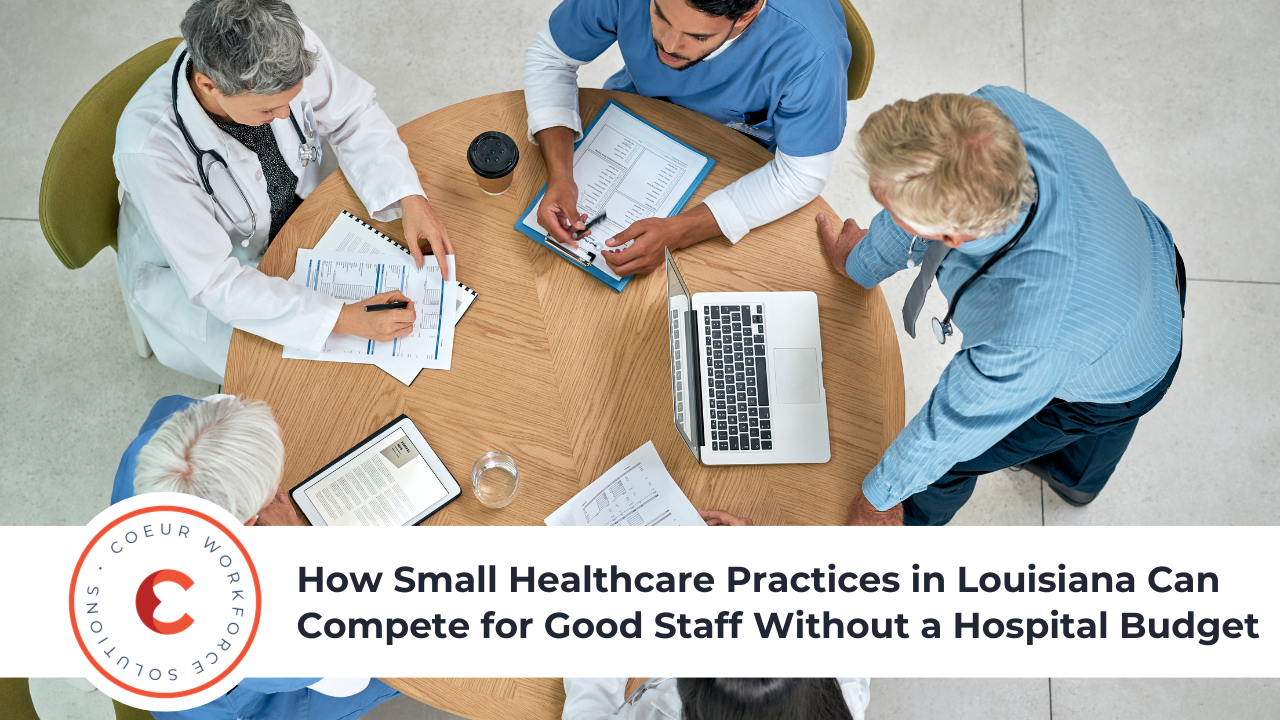
TL;DR: Small healthcare practices in Louisiana are losing good clinical and administrative staff to larger health systems, and it usually comes down to benefits, not pay. The good news: independent practices can offer competitive benefits packages and smarter HR without hiring a full internal HR team. Here is how.
You trained your medical assistant for months. She knew your systems, your patients trusted her, and she made the front office run. Then a regional hospital offered her benefits you could not match, and she was gone in two weeks. Healthcare employee retention at small practices in Louisiana comes down to one uncomfortable truth: your staff is being recruited constantly, and the health systems doing the recruiting have HR departments, benefits packages, and onboarding programs that most independent practices cannot touch. Yet. The word “yet” matters. The gap is smaller than it looks, as long as you have the right support in place. If you want to know what growing businesses in New Orleans should expect from an HR partner, the answer starts with benefits. Here is what your practice can actually do about it.
The Real Reason Your Clinical Staff Keeps Leaving for the Hospital Down the Street
When a nurse, medical assistant, or front desk coordinator leaves for a hospital or large health system, most practice owners assume it was the money. And sometimes it is. But more often than not, the resignation was months in the making, and the hospital’s salary offer was simply the final push.
It Is Not Always the Salary
Research consistently shows that benefits are the second-most-valued element of compensation, right behind pay itself. A recent industry survey found that 56 percent of employees with employer-sponsored health coverage consider the quality of their benefits a major factor in whether they stay. Another survey found that 60 percent of workers said they would leave their current job for better health insurance alone. For clinical staff who understand the healthcare system from the inside, benefits are not an afterthought. They know what excellent coverage looks like, and they notice when their employer is not offering it. When a hospital system offers health insurance, a retirement match, structured PTO, and a clear onboarding process, while your practice offers only a paycheck and not much else, the decision to leave is easy.
What Benefits Gaps Actually Cost You Over 12 Months
The national hospital turnover rate sits at 18.5 percent in 2026, with registered nurse turnover running at 17.6 percent. In small practice settings, medical assistants and front office staff experience even higher churn. Replacing a single clinical employee can cost upward of $61,000 when you account for recruiting, training, lost productivity, and the impact on patient care continuity. For a 15-person practice, losing just two or three staff members a year can drain over $150,000 in direct and indirect costs. That number is almost always higher than what it would cost to offer a competitive benefits package in the first place.
What Small Healthcare Practices Can Realistically Offer in 2026
The assumption that small practices cannot compete on benefits is outdated. The options available in 2026 are more flexible and more affordable than many practice owners realize, especially for businesses with fewer than 50 employees that are not subject to the ACA’s employer mandate.
Health Insurance Options That Do Not Break the Budget
Small group premiums are rising (the median proposed increase for 2026 is around 11 percent), but practices with fewer than 50 employees have access to options that larger employers often do not. The Small Business Health Options Program (SHOP) provides access to group health and dental plans. Health Reimbursement Arrangements, including Individual Coverage HRAs and Qualified Small Employer HRAs, allow practices to reimburse employees for individual health insurance premiums on a tax-free basis without managing a traditional group plan. High-deductible health plans paired with employer contributions to health savings accounts can reduce monthly premium costs while still giving employees meaningful coverage. The key is working with a benefits partner who can evaluate which structure fits your practice size, workforce makeup, and budget. That is where benefits administration built for small practices changes the equation. Instead of guessing at plan structures, you get guidance that matches real options to your real numbers.
Retirement, PTO, and the Perks That Actually Move the Needle
Health insurance gets the most attention, but it is not the only benefit that drives retention. Structured PTO policies, even modest ones, signal that the practice values work-life balance in a profession where burnout is endemic. A simple retirement plan with even a small employer match signals long-term investment in employees. Continuing education stipends are particularly valuable in healthcare, where certifications directly affect career advancement. And flexible scheduling, which costs nothing to offer but requires intentional management, is frequently cited as one of the top reasons clinical staff choose to stay at a smaller practice rather than move to a hospital system where schedules are less negotiable.
How Benefits Administration Support Changes the Math for Independent Practices
Knowing what benefits to offer is one challenge. Actually administering them is another. For small practices without a dedicated HR person, the operational burden of managing enrollment, compliance, plan changes, and employee communication can be just as overwhelming as the cost of the benefits themselves.
Why Managing Benefits In-House Is Riskier Than It Looks
Open enrollment is a compliance event. Getting it wrong, whether that means missing a deadline, failing to communicate plan changes correctly, or making an error in benefits deductions, creates legal and financial exposure. In a small practice where the office manager also handles scheduling, billing, and patient intake, benefits administration often gets pushed to the margins. That is where mistakes happen, and they erode the trust you are trying to build with your employees. When your staff does not understand their benefits, or worse, when their paycheck deductions are wrong, it sends the opposite message from what you intended.
What a Local HR Partner Does That a Software Subscription Cannot
A benefits administration software tool can handle forms and reminders. What it cannot do is evaluate whether your plan structure is the best fit for your workforce, negotiate with carriers on your behalf, or answer an employee’s question about their coverage in real time. Local HR support for your practice means having a team that understands your industry, your size, and your specific compliance environment in Louisiana. It means someone who can walk your office manager through open enrollment, flag issues before they become penalties, and help you design a benefits offering that is genuinely competitive for the staff you are trying to keep.
Beyond Benefits: The HR Practices That Keep Good People Around
Benefits get employees in the door and give them a reason to stay. But the day-to-day experience of working at your practice is what ultimately determines whether they stay.
Onboarding That Sets the Tone From Day One
A well-structured onboarding process does more than get paperwork signed. It communicates professionalism, sets expectations, and reduces the anxiety that comes with starting a new role in a clinical setting. Practices that invest in a consistent onboarding experience, one that includes training timelines, role clarity, and early check-ins, see measurably better retention in the first year. When onboarding is inconsistent, new hires feel it immediately, and that first impression is difficult to reverse.
Consistent Communication and Recognition in a Clinical Setting
Only 18 percent of healthcare workers report working in an environment where recognition happens regularly. Employees who work in a culture of recognition are nearly four times more likely to feel connected to their organization. For a small practice, recognition need not be elaborate. It means acknowledging valuable work in real time, communicating scheduling changes with respect, and ensuring clinical staff feel they have a voice in how the practice operates. These are not expensive initiatives. They are management habits that require consistency, and they have an outsized impact on whether people stay.
How Coeur Helps Louisiana Healthcare Practices Level the Playing Field
Coeur Workforce Solutions works with independent healthcare practices across Louisiana that are facing exactly this challenge: competing for clinical and administrative talent against larger systems with bigger budgets and bigger HR departments. Coeur provides integrated benefits administration, HR advisory support, and workforce management through the UKG Workforce Ready platform, all from a local team based in Baton Rouge that understands the regulatory landscape and labor market conditions specific to Louisiana employers. Instead of patching together separate systems for payroll, benefits, and HR, your practice operates on a single connected platform with a dedicated support team. That means cleaner benefits enrollment, fewer payroll errors, more consistent onboarding, and faster answers when your office manager has a compliance question or an employee has a coverage question. For practices with 10 to 75 employees, that kind of infrastructure is not a luxury. It is what makes it possible to offer the experience your staff compares you to every time a hospital recruiter reaches out.
FAQ: Benefits for Small Healthcare Employee Retention Practices in Louisiana
Why do nurses and clinical staff leave small practices for larger health systems?
The most common drivers are benefits and career progression, not salary alone. Hospital systems typically offer comprehensive health insurance, retirement plans, structured PTO, and visible advancement pathways that small practices struggle to match without outside HR support. When benefits are thin or inconsistent, and there is no clear growth path, even staff who prefer the work environment at a smaller practice will eventually move for the stability and support a larger system provides.
What benefits can a small Louisiana medical practice realistically offer?
More than most practice owners expect. Practices with fewer than 50 employees can access group health plans through SHOP, offer HRAs or QSEHRAs to reimburse employees for individual coverage, pair high-deductible plans with HSA contributions, and provide retirement plans with employer matching. Structured PTO, continuing education stipends, and flexible scheduling round out a genuinely competitive package, especially when administered professionally so employees understand and value what they are receiving.
How does outsourced HR and benefits administration help with staff retention?
When outsourced HR consistently manages benefits and communicates them clearly, employees feel more confident in their compensation package. Outsourced HR also brings structure to onboarding, policy documentation, and compliance monitoring, all of which affect how professional and stable the work environment feels. Practices that invest in HR support spend less time correcting errors and more time creating the kind of workplace that good staff want to stay at.
What is the biggest mistake small healthcare practices make with employee benefits?
Assuming they cannot afford to offer them. The cost of not offering competitive benefits, measured in turnover, recruiting, training, and lost patient continuity, almost always exceeds the cost of a well-structured benefits package. The second biggest mistake is offering benefits without administering them well. A benefit that employees do not understand, cannot access easily, or that creates payroll errors does more harm than good.
You Do Not Have to Outspend the Hospital to Out Retain It
The large health systems have size on their side, but size is not the only thing clinical staff is looking for. Practices that communicate clearly, offer benefits their people can actually use, and handle HR with the same professionalism they bring to patient care are the ones that hold on to good staff year after year. That is achievable for a practice of your size. Review which benefits processes Louisiana employers should automate first to identify your quick wins, or get a quote from Coeur to learn how we help independent practices compete for the talent they deserve.