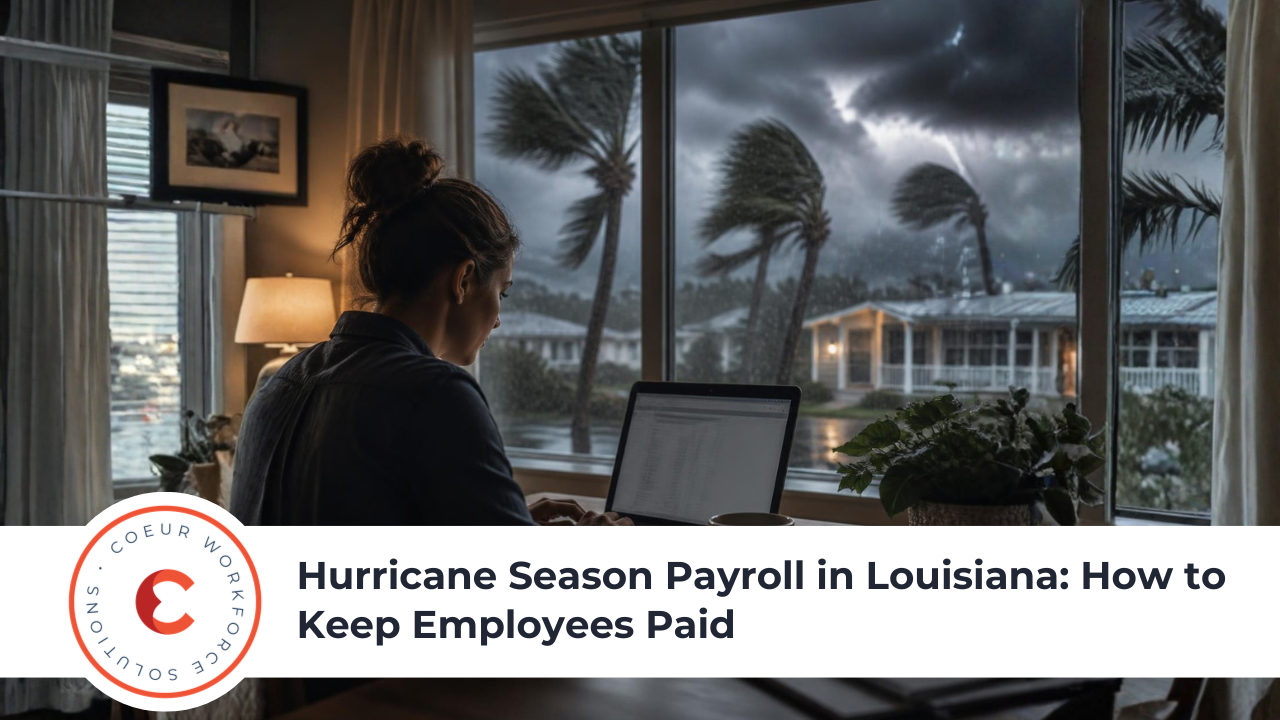

Storm Payroll | Do I have to pay employees during a storm closure is one of the most common questions Louisiana business owners ask the moment a hurricane watch is issued. The honest answer depends less on the weather and more on how each employee is classified under federal wage and hour law.
Get this wrong and you risk wage claims on top of storm damage, which is exactly why so many Louisiana businesses lean on a Louisiana payroll and HR compliance guide long before hurricane season starts, instead of guessing their way through it while a storm is already on the radar.
The Short Answer: It Depends on Exempt vs. Nonexempt Status
Every storm closure question comes back to the same starting point: how is the employee classified. The Fair Labor Standards Act draws a hard line between exempt and nonexempt employees, and that line does not move just because a hurricane forced the office to shut down. Understanding which bucket each employee falls into, before a storm is named, is the single most useful thing a Louisiana employer, whether in New Orleans, Baton Rouge, or anywhere in between, can do to avoid a wage claim during hurricane season.
What You Owe Exempt Employees During a Storm Closure
Exempt employees generally must receive their full weekly salary for any week in which they performed some work, even if the office closed for several days because of a hurricane. Federal law does not allow employers to deduct pay from an exempt employee for a partial-week closure caused by the business itself, and a storm-related shutdown counts as a business decision in the eyes of the Department of Labor, not an act of the employee. Docking an exempt employee’s salary for a storm closure risks the employee’s exempt status altogether, which can turn one missed paycheck into a much larger compliance problem.
What You Owe Nonexempt Employees During a Storm Closure
Nonexempt employees are only owed pay for hours they actually worked, unless a written policy, an employment contract, or state law provides otherwise. If the office is closed and a nonexempt employee performs no work, federal law does not require payment for that time. Many Louisiana employers, from New Orleans to Baton Rouge, choose to pay nonexempt staff for some or all of a storm closure anyway, as a goodwill practice, but that is a business decision rather than a legal requirement.
Reporting Time Pay Rules to Watch For
Some states require reporting time pay when an employee shows up for a scheduled shift only to be sent home early, though Louisiana does not currently have a reporting time pay statute on the books. Even without a state requirement, a written policy on how partial shifts are handled during a storm closure keeps expectations consistent and avoids confusion when an employee travels to a workplace that ends up closing partway through the day.
Can You Require Employees to Use PTO During a Hurricane Closure?
Yes, in most cases you can require nonexempt employees to use accrued PTO for a storm closure, as long as your policy is written down and applied consistently across your workforce. Some Louisiana paid sick leave ordinances may limit this in certain parishes or municipalities, so it’s worth checking any local requirements before enforcing a mandatory PTO policy. Consistency matters here: a policy applied unevenly across employees creates more legal exposure than a strict policy applied the same way to everyone.
What Happens If the Closure Lasts More Than a Week
A short closure is manageable with existing PTO balances and a clear pay policy, but a closure that stretches past a week, which is not unusual after a major hurricane, changes the math. Employees may exhaust PTO, exempt employees still need their full salary for any week with work performed, and cash flow for the business itself may be strained by storm damage at the same time payroll is due. This is where having payroll on a cloud-based platform, rather than one tied to a single office location, becomes less of a convenience and more of a necessity, since payroll still has to run on schedule regardless of how long the physical office stays closed.
Building a Written Storm Closure Pay Policy Before You Need One
A written storm closure pay policy should cover how exempt and nonexempt pay is handled, whether PTO use is required or optional, how partial shifts are paid, and how the business will communicate a closure decision to employees. It should also address how employees will actually get paid if a closure disrupts normal channels. Employees who receive direct deposit are the easiest to plan for, since funds move electronically and are not affected by a closed office. Employees who still receive a paper check are a bigger risk during a storm, since FedEx and other carriers routinely slow or suspend service in a hurricane’s path, leaving a mailed check stuck for a week or more exactly when an employee needs it most. Employees who don’t have a bank account can be moved onto a Rapid Card, a reloadable payroll card that receives funds electronically on payday the same way direct deposit does, so no one on the team is left depending on mail delivery during a closure. Writing this into the policy now, rather than sorting it out during an active storm, means every employee has a way to get paid on time no matter how long the office stays closed.
How Coeur Handles This for Clients Before the Storm Even Forms
Coeur has spent 24 years helping businesses across Louisiana, from New Orleans to Baton Rouge, build storm closure pay policies that hold up when a hurricane actually arrives. That includes reviewing exempt and nonexempt classifications, documenting PTO and closure pay rules, and moving clients off paper checks and onto direct deposit or a Rapid Card so a shipping delay never becomes a payroll problem. Clients also run on cloud-based time and attendance management, so hours are accurate and accessible no matter where an employee or manager is working from during a closure.
Frequently Asked Questions
Do I have to pay employees if my Louisiana business closes for a hurricane?
It depends on classification, not on how long the storm lasts. Exempt employees generally must receive their full salary for any week they perform some work, while nonexempt employees are only owed pay for hours they actually worked, unless your written policy, an employment contract, or state law provides otherwise.
What’s the difference between exempt and nonexempt pay during a storm closure?
Exempt employees must receive their full weekly salary if they performed any work that week, even if the office closed for several days. Federal law does not allow employers to deduct pay from an exempt employee for a partial-week closure caused by the business itself, including hurricane-related shutdowns.
Can I require employees to use PTO during a hurricane closure?
Yes, in most cases you can require nonexempt employees to use accrued PTO for a storm closure, as long as your policy is written down and applied consistently. Some Louisiana paid sick leave ordinances may limit this, so check any local requirements before enforcing a mandatory PTO policy.
What happens to my payroll if I lose power during a storm?
Losing power at your office does not have to stop payroll if your system is cloud-based. Payroll data lives on secure remote servers, so you or your HR partner can process and approve payroll from any location with an internet connection, keeping direct deposits on schedule.
What if some of my employees still get paid by paper check?
Paper checks are the riskiest way to get paid during a storm, since FedEx and other carriers routinely slow down or suspend service along a hurricane’s path. Employees with direct deposit are not affected by mail delays, and employees without a bank account can be moved onto a Rapid Card, a reloadable payroll card funded electronically on payday, so no one is left waiting on a shipment that may not arrive.
Where can employees get help if they lose wages because of a hurricane in Louisiana?
Employees who lose income because of a hurricane may qualify for Disaster Unemployment Assistance through the Louisiana Workforce Commission, which covers workers not eligible for regular unemployment benefits. Employers should share this resource with staff proactively rather than waiting for employees to ask after a storm hits.
One written policy away from a stress-free storm season. Talk to our HR experts.
Don’t Wait for a Storm Warning to Learn Your Payroll Obligations
The businesses that handle hurricane season best in Louisiana, from New Orleans to Baton Rouge, are the ones that already know their pay obligations before a storm is named. Exempt and nonexempt rules don’t change because the weather does, and a written policy takes the guesswork out of a stressful week for you and your team.
If you’re not sure your current payroll policy would hold up during a real closure, our HR experts can review it before hurricane season peaks. You can also check your filing deadlines against our Baton Rouge payroll tax deadlines and filing checklist so nothing slips through the cracks.