
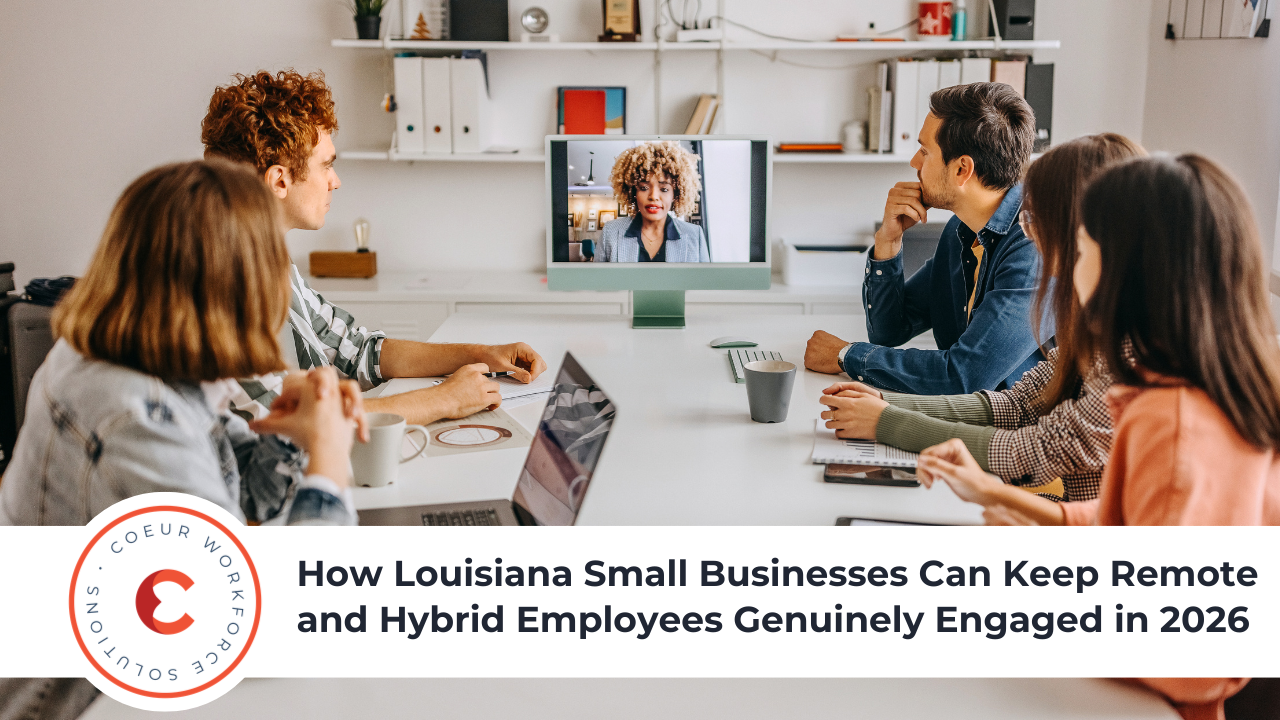
Managing remote and hybrid employees has gone from an emergency fix to an everyday reality, but keeping those employees genuinely engaged is still something most small businesses are figuring out on the fly. If your remote team seems less connected, less motivated, or harder to manage than your in office staff, you’re not imagining it. Remote employee engagement for small businesses in Louisiana requires more than a Zoom happy hour. It takes intentional communication, the right tools, and HR practices that actually fit how your business works. Here’s what to focus on in 2026.
Why Remote Employee Engagement Is Harder Than It Looks for Small Businesses
On paper, remote and hybrid work should be a win for everyone. Employees get flexibility. Businesses get access to a wider talent pool. But the reality for small businesses in Baton Rouge and New Orleans is more complicated than that.
When your team is split between the office and their living rooms, the informal moments that build trust and connection start to disappear. There’s no hallway check in. No quick lunch conversation where someone mentions they’re feeling overwhelmed. And for businesses with 15 to 75 employees, where every person carries real weight, that disconnect can quietly chip away at performance and morale.
The numbers back this up. Only about 31% of U.S. employees are actively engaged at work right now, and that number has been trending downward since 2020. Managers account for roughly 70% of the variance in team engagement levels. So if your managers aren’t equipped to lead remote employees with the same intentionality they bring to in person teams, engagement will suffer regardless of how good your benefits package looks.
The biggest challenge of managing remote employees isn’t the logistics. It’s the distance between intention and execution. Most business owners want their people to feel connected. They just don’t have the systems in place to make that happen consistently.
Communication: The Foundation That Either Connects or Fragments a Remote Team
Every engagement problem in a remote or hybrid setup eventually traces back to communication. Not just how often your team talks, but how well.
For small businesses, the temptation is to rely on whatever tools are already in place. A group text here. A Slack channel there. Maybe a Monday morning call that half the team dials into late. But inconsistent communication creates inconsistent expectations, and that breeds frustration on both sides.
What works in 2026 is what some experts are calling “structured flexibility.” That means giving your team the autonomy to manage their own time while building in consistent communication rhythms that keep everyone aligned. Think weekly team syncs, monthly one on ones, and clear channels for different types of updates so nothing important gets buried in a thread nobody checks.
The goal isn’t to over communicate or micromanage. It’s to make sure your remote employees feel just as informed and included as the person sitting in the next office. When that foundation is in place, most of the other engagement challenges become a lot easier to solve.
Recognition That Reaches Across the Screen. Why Virtual Doesn’t Mean Less Meaningful
One of the fastest ways to lose a remote employee’s engagement is to let their work go unnoticed. And it’s easier than you think for that to happen when someone isn’t physically present.
In an office, a manager might casually thank someone in a meeting or stop by their desk to acknowledge a job well done. Remote employees rarely get those moments, and over time, the absence of recognition starts to feel like indifference.
Research consistently shows that employees who feel recognized are significantly less likely to leave their jobs. Nearly 80% of employees say that regular recognition improves their loyalty to their organization. But it has to be genuine and timely, not a generic “great job” email sent to the whole team once a quarter.
For small businesses, this doesn’t need to be complicated or expensive. A direct message from a manager calling out a specific contribution. A shoutout during a team call. A note in a weekly update. The format matters far less than the consistency. The businesses that make recognition a habit, not an afterthought, are the ones keeping their remote teams motivated.
Remote work isn’t going anywhere. Neither should your best people. Get a Quote
Growth and Development Opportunities Your Remote Employees Are Hoping You’ll Offer
Here’s something that catches a lot of small business owners off guard: remote employees want to grow just as much as in office employees, but they’re far less likely to ask for it. Out of sight can quickly become out of mind when it comes to development conversations, and remote workers know it.
Nearly 20% of employees say remote work options directly impact how well they perform. But performance and engagement both drop when people feel like they’re stuck, doing the same tasks with no path forward and no one checking in on their professional goals.
Growth doesn’t have to mean a title change or a salary bump. It can mean cross training on a new system, leading a small project, attending a virtual conference, or simply having a quarterly conversation about where someone wants to be in a year and what you can do to support that. Companies that invest in upskilling and development retain measurably more employees, and those investments pay for themselves many times over in reduced turnover costs.
If you haven’t had a development conversation with your remote team members recently, that’s the place to start.
Using HR Technology to Make Remote Management Less Chaotic
Managing a distributed team with spreadsheets, email chains, and a mental checklist of who’s doing what is a recipe for things falling through the cracks. And when things fall through the cracks, your remote employees are usually the first to feel it.
HR technology for remote teams in Louisiana has come a long way. The right platform can give you a single place to manage time tracking, performance reviews, employee records, and communication, all accessible from anywhere. That’s not a luxury for businesses with hybrid teams. It’s a necessity.
A mobile accessible HR platform levels the playing field between your in office and remote staff. When employees can clock in, request time off, access their pay information, and complete onboarding tasks from their phone or laptop, the experience feels seamless regardless of location. And when managers have real time visibility into their team’s hours, tasks, and milestones, they can actually manage proactively instead of reactively.
The key is choosing technology that fits your size. Small businesses don’t need an enterprise level system with 200 features they’ll never use. They need something streamlined, intuitive, and backed by people who can help them actually implement it. That’s where working with a local partner makes a real difference.
Building a Culture That Includes Everyone. Not Just the People in the Office
Culture is one of those things that’s hard to define but easy to feel. And for remote and hybrid teams, the biggest cultural risk isn’t toxicity. It’s invisibility.
When only part of your team is in the building, it’s natural for conversations, decisions, and social bonds to form around whoever’s physically present. Over time, remote employees start to feel like they’re on the outside looking in, even if that’s never anyone’s intention.
Building a culture that genuinely includes remote workers takes deliberate effort. That means making sure meetings are structured so remote participants can contribute equally, not just listen. It means sharing information through channels everyone can access, not just in side conversations after a meeting ends. And it means creating touchpoints, virtual or otherwise, that give remote employees a sense of belonging.
This is also where having a strong HR structure matters. A clear employee handbook, a consistent onboarding process, and documented policies that apply equally to everyone, regardless of where they work, all go a long way toward building the kind of culture that holds hybrid teams together.
Work Life Balance Isn’t Just a Perk. It’s a Retention Strategy
Remote work was supposed to improve work life balance. And for many employees, it has. But for others, especially those in small businesses where boundaries tend to be looser, remote work has blurred the line between “always available” and “always on.”
Research shows that fully remote workers report higher rates of daily stress than their in office counterparts. Nearly 45% of remote employees say they experienced significant stress the day before being surveyed, compared to about 39% of on site workers. And while remote employees often report higher engagement, their overall wellbeing can actually be lower than hybrid workers who get the benefit of both flexibility and in person connection.
For Louisiana business owners, the takeaway is clear: flexibility alone isn’t a retention strategy. You also need to model and protect healthy boundaries. That means being mindful of after hours messages, encouraging actual time off, and paying attention when someone on your team seems to be burning out.
The businesses that get this right aren’t just keeping employees longer. They’re getting better work from happier people.
What Louisiana Business Owners Should Be Tracking for Remote Engagement
You can’t improve what you’re not measuring. And for most small businesses managing remote or hybrid teams, engagement tracking starts and ends with a gut feeling. That’s not enough.
Here are a few things worth paying attention to consistently. Track voluntary turnover by work arrangement to see whether your remote employees are leaving at higher rates than in office staff. Monitor participation in meetings, training, and company events to spot disengagement early. Use short pulse surveys, even quarterly, to ask your team how they’re feeling about communication, workload, and connection. And pay attention to manager check in frequency, because data consistently shows that employees who have regular conversations with their managers report higher engagement and are far less likely to leave.
None of this requires sophisticated software. It requires attention and a commitment to acting on what you learn. If you want to go deeper, working with an HR partner who understands hybrid workforce management in Baton Rouge and across Louisiana can help you build a tracking system that actually drives results.
FAQ: Remote and Hybrid Employee Engagement for Small Businesses
How do you keep remote employees engaged and motivated?
Start with consistent, structured communication. Weekly team check ins and monthly one on ones create a rhythm that keeps people connected. Layer in regular recognition, development conversations, and clear expectations, and you’ve built a foundation that keeps remote employees engaged without overcomplicating your workflow.
What HR tools help manage remote teams for small businesses?
Look for an all in one HR platform that includes time tracking, performance management, employee self service, and mobile access. The goal is to give both managers and employees a single place to handle the day to day, no matter where they’re working from. A platform backed by a local support team, rather than a faceless national call center, makes implementation and troubleshooting far smoother.
How do you build company culture with a hybrid workforce?
Culture in a hybrid environment comes down to intentional inclusion. Structure meetings so remote employees participate equally. Share decisions and updates through digital channels everyone can access. Create consistent onboarding and policy documentation so the employee experience doesn’t depend on physical location. And make time for informal connection, even virtually, so remote workers don’t feel like afterthoughts.
What is the biggest challenge of managing remote employees?
The biggest challenge is maintaining visibility, both for managers and for the employees themselves. Managers lose the ability to read body language and pick up on disengagement cues. Employees lose the casual interactions that build trust and make them feel like part of the team. Solving this requires a combination of communication structure, the right technology, and managers who are trained to lead distributed teams with the same care they bring to in person ones.
Engagement Doesn’t Happen by Accident. Especially for Remote Teams
Keeping your remote and hybrid employees motivated takes more than good intentions. It takes consistent HR practices and the right technology working together. Louisiana small businesses that invest in clear communication, meaningful recognition, and scalable HR tools are the ones holding onto their people while competitors deal with constant turnover.
Curious about what that looks like in practice? Read about what growing businesses should expect from HR services in New Orleans, or get a quote from Coeur to see how our HR platform and local support team can help you manage your workforce, wherever they’re working from.