
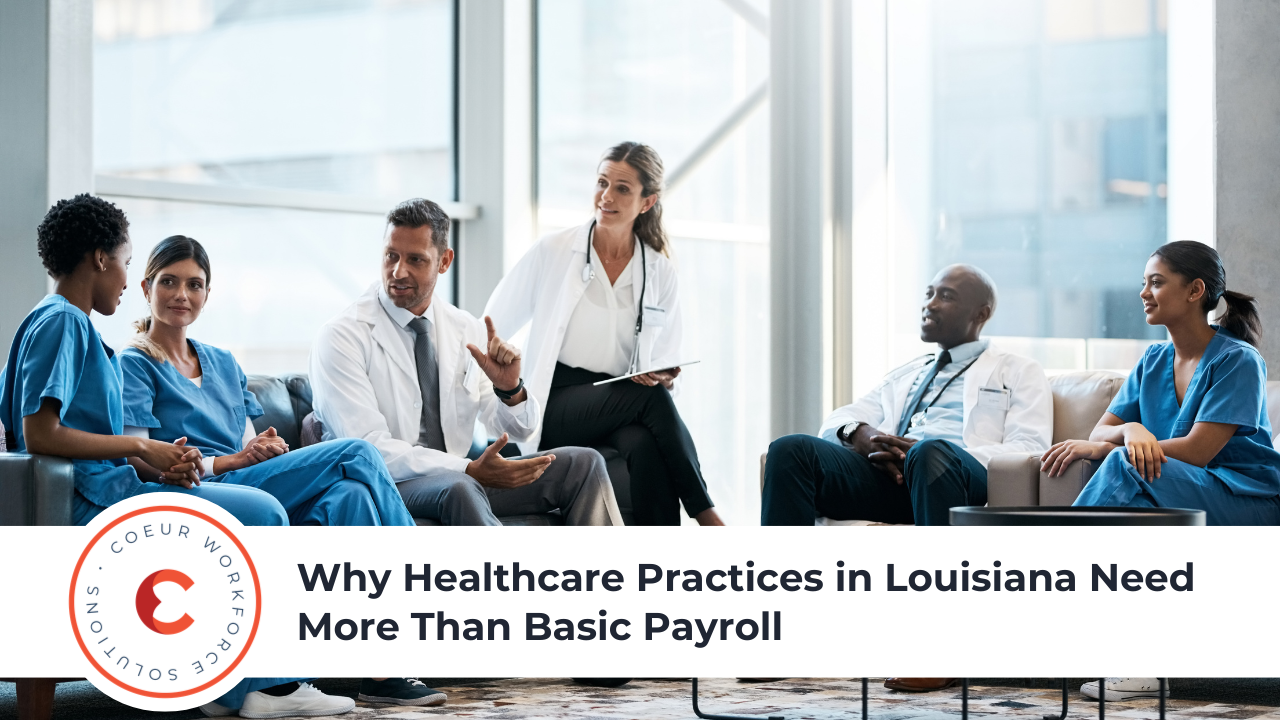
Running a healthcare practice in Louisiana is demanding enough before payroll even comes into play. But payroll for medical and dental offices is genuinely more complex than most standard payroll tools can handle. Between shift differentials, overtime for clinical staff, on-call pay, and the mix of salaried, hourly, and per diem workers, payroll services for healthcare practices in Louisiana need to account for variables that a basic setup will consistently miss. One miscalculation can ripple into a compliance issue, an underpaid staff member, and a retention problem you did not see coming. If you have started to wonder whether your payroll process is keeping up, you are asking the right question. Here is what your practice actually needs in 2026.
Healthcare Payroll Is Not One-Size-Fits-All, and Basic Tools Treat It Like It Is
Most payroll platforms are designed for businesses where every employee clocks in at the same time, earns the same rate, and goes home at the end of a predictable shift. That is not how healthcare works. Even a small practice operates with more payroll complexity than many mid-sized businesses in other industries, and that complexity only grows as headcount increases.
The Employee Mix That Makes Payroll Complicated
A single medical or dental office may employ full-time salaried providers, hourly clinical staff, part-time front-desk workers, and per-diem or contract professionals. Each of those classifications carries different pay rules, benefit eligibility requirements, and tax obligations. When your payroll tool treats them all the same, errors start compounding. The office manager running payroll through a basic platform has to manually track the distinctions that a healthcare-ready system would handle automatically.
Shift Differentials, On-Call Pay, and Overtime Done Wrong
Clinical staff often work evenings, weekends, and rotating shifts that trigger differential pay. On-call hours add another layer. And overtime calculations in healthcare are not as simple as “anything over 40 hours.” When shift differentials are not factored into the regular rate of pay before overtime is calculated, you end up underpaying employees and creating a wage-and-hour liability. Hospitals and residential care facilities may also qualify for the FLSA’s 8-and-80 overtime exception, which changes the calculation entirely. A basic payroll tool does not account for any of these factors without significant manual intervention, and it is in manual intervention that errors occur.
Compliance Is a Moving Target for Louisiana Medical Practices in 2026
Healthcare payroll compliance is not something you set up once and forget. The rules shift, the enforcement tightens, and the consequences for getting it wrong continue to grow.
What Changed This Year That Affects Your Payroll
In 2026, payroll reporting requirements have expanded at the federal level. Employers are now expected to track and classify compensation types with more granularity, including shift differentials, overtime premiums, and certain bonus categories. The IRS is validating payroll data in real time, which means errors that once went unnoticed are now flagged faster. Louisiana also updated its nonresident employee withholding threshold from 25 days to 30 days, which affects practices employing traveling clinicians or locum tenens providers. On top of that, new limits on physician noncompetes in Louisiana are changing how medical practices create employment agreements and retention strategies. For practices without a dedicated HR resource, keeping up with all of these changes while also managing patient care is a tall order.
The Real Cost of Misclassifying a Worker in Healthcare
Worker misclassification remains one of the most common and most expensive payroll compliance failures. Labeling a full-time clinical employee as an independent contractor, or incorrectly classifying someone as exempt from overtime, exposes your practice to back taxes, back wages, and penalties that can reach thousands of dollars per worker. The Department of Labor collected $318 million in back pay and penalties in fiscal year 2025, and enforcement is accelerating. Healthcare is one of the industries the DOL targets most frequently for audits, particularly practices that rely on a mix of employee types and contract workers.
What Your HR Setup Needs to Handle (That Yours Probably Does Not)
Healthcare payroll management for a small practice goes beyond cutting checks. The systems supporting your payroll need to account for the clinical realities of how your staff works and what they are required to maintain.
Credential and License Tracking Tied to Pay
Nurses, medical assistants, dental hygienists, and other clinical roles often have pay rates tied to active licenses, certifications, or specialized credentials. When a credential expires or a new certification is earned, payroll should automatically reflect the change without requiring someone to manually update a spreadsheet. A disconnected system creates gaps in which an employee’s pay does not reflect their current qualifications, or, worse, where a lapsed credential goes unnoticed, putting the practice at risk. HR technology that keeps up with your schedule should connect credentialing data to payroll automatically so you don’t miss anything.
Time and Attendance That Actually Reflects How Shifts Work
Healthcare scheduling does not follow a nine-to-five pattern. Overlapping shifts, split shifts, early morning starts, and weekend rotations are standard. When time and attendance live in a separate system from payroll, someone has to manually bridge the two, and that bridge is where overtime gets miscalculated, shift differentials get missed, and on-call hours get recorded incorrectly. Practices that use time and attendance tools built for shift-based teams on the same platform as their payroll eliminate that manual step and reduce the risk of errors that come with it.
See how the right payroll and HR setup protects your practice from costly compliance gaps.
Why Outsourced HR and Payroll Makes Sense for Small Practices
A common misconception is that outsourced HR and payroll are only for large organizations. In reality, small healthcare practices often benefit the most because they carry the same compliance obligations as larger employers but without the internal staff to manage them.
What You Get That an In-House Administrator Cannot Always Provide
HR outsourcing for clinics in Louisiana gives your practice access to compliance monitoring, benefits administration, onboarding infrastructure, and HR advisory support that would require multiple full-time hires to replicate internally. Your office manager should not have to be a payroll specialist, a benefits coordinator, and an employment law expert all at once. A full-service HR partner handles those responsibilities, so your team can focus on patient care. And when you pair that with benefits administration that your staff will actually use, employees get a better experience, and your practice reduces administrative overhead.
The UKG Workforce Ready Difference for Healthcare Teams
Coeur Workforce Solutions partners with UKG to deliver Workforce Ready, an integrated platform that connects payroll, HR, time and attendance, and benefits administration within a single system. For healthcare practices, that integration means shift differentials and overtime are calculated correctly every time, credential-linked pay adjustments occur automatically, and your compliance data is always up to date. Instead of patching together three or four disconnected tools and hoping the data transfers cleanly, everything operates from a single source of truth. That is the difference between payroll that runs and payroll that actually works.
What to Look for in a Local HR and Payroll Partner for Your Practice
Not every payroll provider understands healthcare, and not every HR company can support the specific needs of medical and dental offices. When evaluating a partner for your practice, search for experience with healthcare payroll complexity, including shift differentials, mixed employee classifications, and credential tracking. Ask whether their platform integrates payroll, timekeeping, and HR in one system or relies on separate tools that require manual data transfers. Ask about compliance support: do they proactively flag regulatory changes, or do they wait for you to ask? And ask whether your account gets a dedicated local team or routes through a national call center. If you have noticed the signs your practice has outgrown its current payroll setup, a local partner who knows Louisiana employment law and healthcare operations is the practical next step.
FAQ: HR and Payroll for Healthcare Payroll Services in Louisiana
What makes healthcare payroll services more complicated than regular payroll?
Healthcare practices typically employ a mix of salaried providers, hourly clinical staff, part-time workers, and per diem or contract professionals. Each classification has different pay rules, tax implications, and benefit eligibility. On top of that, shift differentials, on-call pay, overtime calculations that factor in non-discretionary pay, and credential-linked compensation all add layers of complexity that standard payroll tools are not designed to handle without significant manual workarounds.
How do you handle shift differentials and overtime for clinical staff?
Shift differentials for evening, weekend, and holiday work must be included in the regular rate of pay before overtime is calculated. This means overtime is not simply 1.5 times the base hourly rate; it is 1.5 times the blended rate that includes all applicable differentials and non-discretionary pay. Getting this wrong results in systematic underpayment. An integrated payroll and time system that applies differential codes and calculates blended rates automatically is the most reliable way to stay compliant.
Can a small Louisiana medical practice afford outsourced HR and payroll?
Yes. Outsourced HR and payroll services are typically priced on a per-employee, per-month basis, which scales with your workforce. For many small practices, the cost is comparable to or lower than the combined expense of managing payroll, timekeeping, HR documentation, and compliance monitoring across multiple disconnected systems. The reduction in error risk, time savings, and access to HR expertise make the investment practical even for practices with a small team.
What happens if a practice misclassifies an employee in 2026?
Misclassifying a worker as an independent contractor or incorrectly classifying someone as exempt from overtime can result in back taxes, back wages, and penalties that reach thousands of dollars per worker. Federal enforcement is accelerating, and the DOL frequently targets the healthcare sector for audits. Beyond the financial penalties, misclassification can also trigger employee trust issues and retention problems that are harder to quantify but just as damaging.
Your Practice Deserves a Payroll Setup Built for How You Actually Operate
Your clinical team shows up and takes care of patients. Your payroll and HR setup should take care of them in return, accurately, on time, and in full compliance with the rules that govern healthcare employers in Louisiana. Generic payroll tools were not built for practices like yours, and the gaps add up quickly. If you are not confident your current setup is covering everything it should, that is worth a conversation. Check out the signs your practice may have outgrown its current payroll setup, or get a quote from Coeur today to see what a healthcare-ready solution looks like for your team.